

Project overview
Our client needed to streamline and automate the CI/CD pipeline for their Java application running on Kubernetes, ensuring both code quality and security compliance across the development and deployment lifecycle. They wanted a solution that could accelerate delivery while reducing manual effort.
Challenges
- Manual code reviews and security scans: Code quality and security vulnerabilities were inconsistently addressed, leading to delays and increased risk.
- Continuous integration and delivery: Manual builds and deployments increased the likelihood of human error.
- Security compliance: Robust, automated security checks for Docker images and Kubernetes deployment files were needed to maintain compliance.
Proposed solution & architecture
Unified Techs designed and implemented a fully automated CI/CD pipeline using AWS native services, focusing on both code quality and security. The solution ensured that every step — from code commits to Kubernetes deployments — was automated, secure and consistent. The pipeline included the following key stages:
Pipeline stages
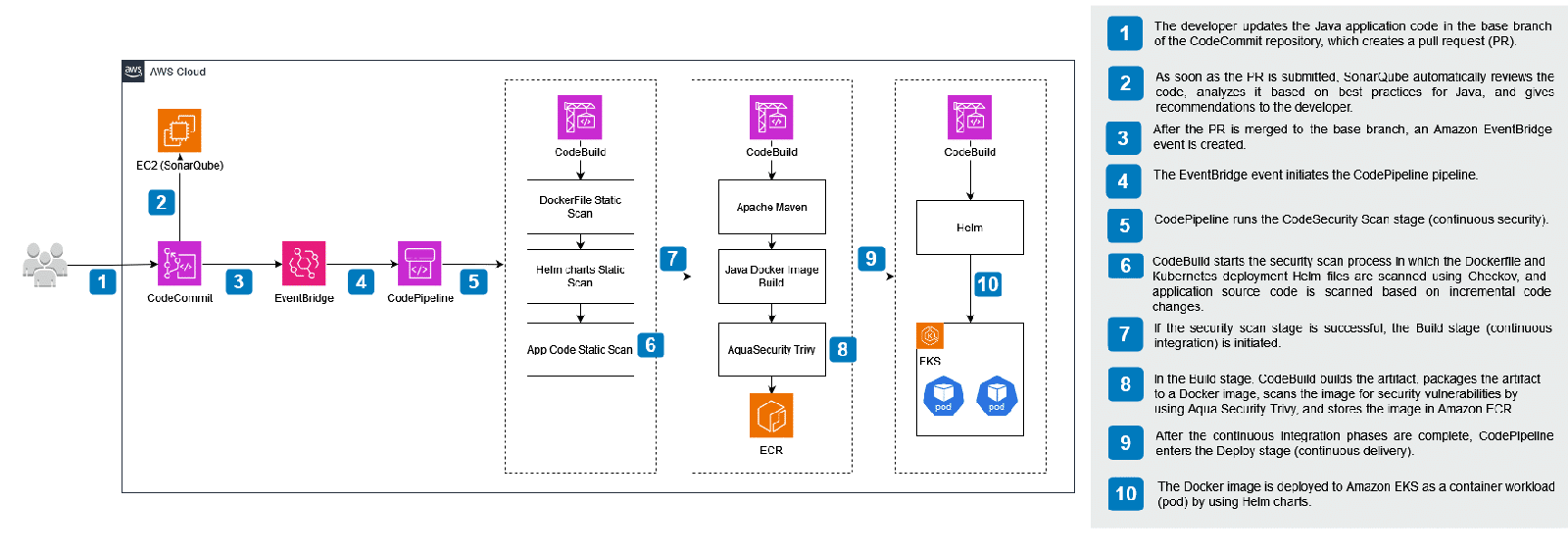
- Code review automation with SonarQube: When a developer submits a pull request in the CodeCommit repository, SonarQube automatically analyzes the Java code for best practices and provides direct feedback.
- Event-driven pipeline triggering: After a pull request merge, Amazon EventBridge triggers the CI/CD pipeline automatically, eliminating the need for manual starts.
- Continuous security scanning: CodeBuild scans the Dockerfile and Kubernetes Helm deployment files using Checkov. Aqua Security Trivy scans the resulting Docker image for vulnerabilities before pushing it to Amazon Elastic Container Registry.
- Continuous integration and build: CodeBuild packages the artifact into a Docker image and verifies that it meets security standards before allowing it to proceed to deployment.
- Continuous delivery to Kubernetes: The Docker image is automatically deployed to Amazon EKS using Helm charts, ensuring consistent, repeatable and secure deployments.
Architecture
Metrics for success
- Improved code quality: Automated analysis reduced manual review time and improved adherence to standards.
- Enhanced security: Vulnerabilities were identified early, lowering the risk of production issues.
- Faster time to production: Deployment times were reduced by 50% through automation.
- Increased developer efficiency: Developers could focus on coding while the pipeline handled testing, security scanning and Kubernetes deployments.
Lessons learned
- Automation enhances security: Continuous scanning integrated into the pipeline improved compliance and reduced vulnerabilities.
- Efficiency through integration: Automating the CI/CD process from code commits to Kubernetes deployments boosted both speed and reliability.
Technologies used
AWS CodeCommitAWS CodeBuildAmazon EventBridgeAmazon ECRAmazon EKSSonarQubeCheckovAqua Security TrivyHelmDocker