

Project overview
ConnectAI's call center solution required efficient post-call processing, including saving call recordings and analyzing call data. To achieve this, the team transitioned from a purely event-driven system to AWS Step Functions for workflow orchestration. This change addressed complexity, improved observability and increased data consistency. Previously, the solution relied on a series of event notifications triggered by actions such as saving recordings to an S3 bucket. This event-driven architecture faced several challenges:
Challenges
- Complex event chaining: Multiple AWS services like SNS and Lambda triggered each other in a complex chain.
- Difficult root cause analysis: Debugging across a distributed event-driven system took considerable time.
- Data inconsistency: The asynchronous nature of events caused missed or out-of-order processing.
- Limited observability: Tracking progress across multiple services lacked visibility.
- Operational overhead: Managing many loosely coupled components increased maintenance effort.
Proposed solution & architecture
Unified Techs replaced the existing architecture with AWS Step Functions to manage the entire post-call processing workflow.
AWS Step Functions orchestration
- State machine orchestration: Defined each step — from fetching recordings to analyzing calls and storing results — in a clear state machine.
- Sequential and parallel execution: Managed both sequential and parallel processes for optimal data flow.
- Error handling and retries: Built-in error handling, retries and failure paths improved fault tolerance.
- Enhanced observability: Provided a visual workflow showing real-time execution states, logs and detailed metrics.
Architecture
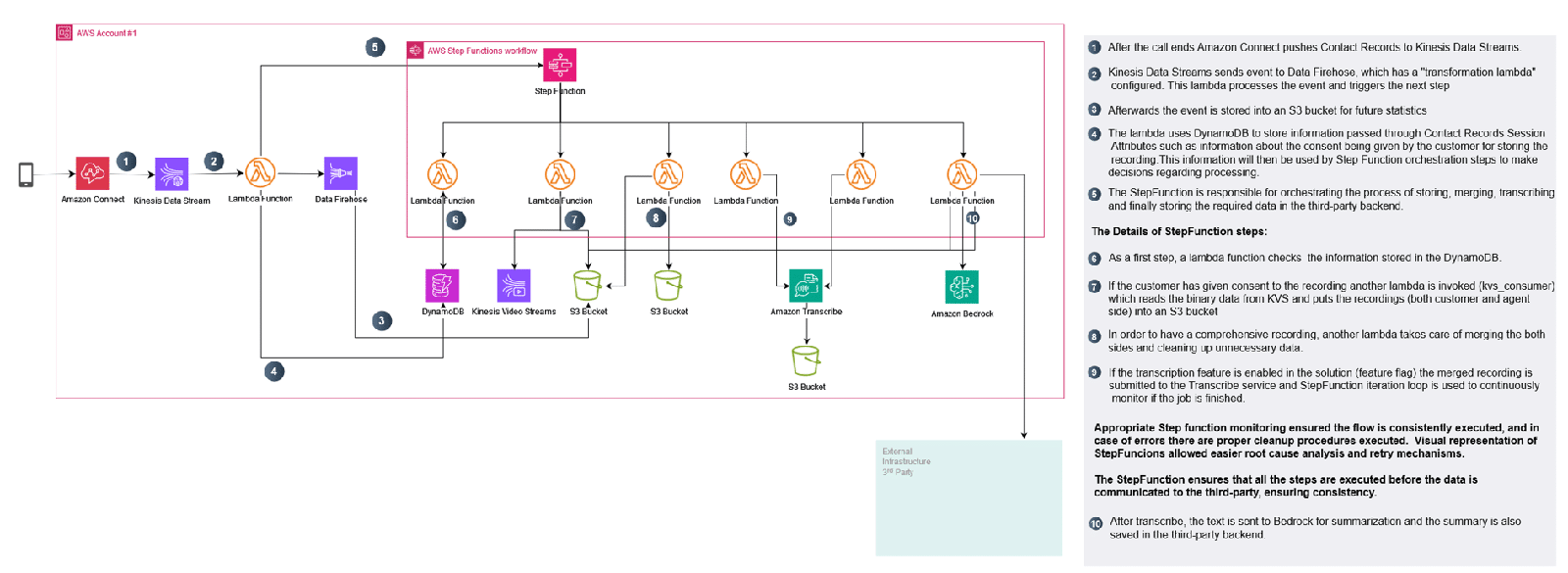
Key improvements
- Single orchestration point: Centralized control using AWS Step Functions eliminated the need for multiple event sources.
- Better monitoring: Visual workflows improved observability, allowing quick identification of failures.
- Consistent data flow: Managed steps reduced missed or out-of-order events.
Metrics for success
- Reduced error rates: Errors dropped by 90% due to more consistent workflows.
- Improved observability: Monitoring time for root cause analysis decreased by 70%.
- Data consistency: Achieved 100% consistency in post-call data processing.
- Operational efficiency: Lowered operational overhead by 50% through streamlined workflow management.
Lessons learned
- State machines simplify complexity: Moving to AWS Step Functions made workflows easier to manage and debug.
- Built-in error handling increases reliability: Retry and error paths reduced failures.
- Observability improves maintenance: Visual insights from Step Functions were essential for quick diagnostics.
- Centralized workflow management saves time: Consolidating processes into one orchestration service reduced the load on development and operations teams.
Technologies used
AWS Step FunctionsAWS LambdaAmazon S3Amazon SNSAmazon CloudWatch